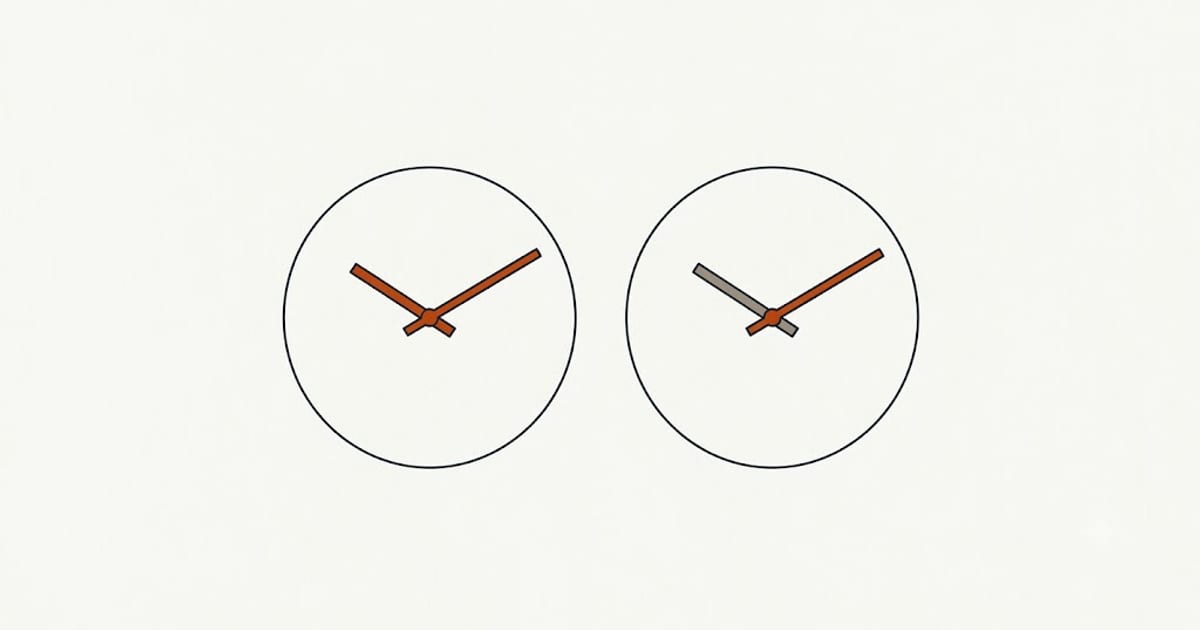
Tokyo is 14 hours ahead of New York from early November to mid-March, and 13 hours ahead the rest of the year.
| Period | Offset |
|---|---|
| New York on standard time (Nov–Mar) | Tokyo +14 h |
| New York on daylight time (Mar–Nov) | Tokyo +13 h |
Why it changes when only one city changes
Japan is UTC+9 all year. It has not observed daylight saving since the late 1940s.
New York alternates between UTC−5 in winter and UTC−4 in summer. When New York springs forward, the gap narrows by an hour without anything happening in Tokyo.
The two changeover dates are the source of most scheduling errors on this pair. A recurring meeting set in March shifts by an hour relative to Tokyo without anyone changing it, and the calendar entry looks unchanged because it is unchanged — in New York.
The overlap
With a 13 or 14-hour gap, ordinary working hours do not overlap at all. 9 am to 5 pm in New York is 10 pm to 6 am in Tokyo.
The workable windows, in summer at 13 hours:
| New York | Tokyo | Comment |
|---|---|---|
| 7:00–9:00 pm | 8:00–10:00 am next day | Tokyo's morning, New York's evening |
| 8:00–9:00 am | 9:00–10:00 pm same day | New York's morning, Tokyo's late evening |
The evening-to-morning window is the more sustainable one. It asks New York to work late rather than asking Tokyo to work late, and Tokyo's morning is a normal working period rather than an intrusion.
In winter at 14 hours, both windows shift an hour and the second one closes almost entirely.
The date, not just the time
Tokyo is ahead by more than half a day, which means it is frequently on the next calendar date.
Monday 6:00 pm in New York is Tuesday 8:00 am in Tokyo (summer). A "Monday morning call" agreed in New York is a Tuesday morning call in Tokyo, and both parties can leave that conversation believing they agreed.
The reliable habit is to state both local times and both dates in writing when confirming anything: "Monday 7 pm New York / Tuesday 8 am Tokyo". It costs a line and removes the entire class of error.
Scheduling that survives the changeovers
Set recurring meetings in one anchor zone and let the other float. Trying to hold both fixed is impossible twice a year.
Use calendar software with real time zone support, entering the meeting in a named zone rather than as a bare local time. Software that stores the zone handles the changeovers; software that stores a wall-clock time does not.
Note that the changeover dates differ worldwide. Europe and North America switch on different weekends, so a three-way meeting can have two separate weeks of disruption.
Jet lag runs the other way
Eastbound travel — New York to Tokyo — is generally harder to adjust to than westbound, because it requires advancing the body clock rather than delaying it. The rough rule is a day of adjustment per hour of offset, which on this pair is close to two weeks for full adaptation.
Most travellers never fully adapt on a one-week trip, which is a practical argument for scheduling important meetings for the local morning after an eastbound arrival rather than the local afternoon.
Offsets are unrelated to durations: a flight time is set by distance and wind, not by the number of zones crossed, and ground distance follows different rules again.